


Cyberlife: "Technology is not the message, vibration is"
- Andrea Ghidorzi

- 9 feb
- Tempo di lettura: 15 min
Cyberlife is not about defining a sound. It's about following a feeling.

For Cyberlife, making music starts from a very simple place: listening inward and allowing things to take shape naturally. There is no pressure to belong, no need to fit into a scene, only time and the patience to follow where sound wants to go. Ambient textures and dancefloor structures coexist without friction. Melodies remain open, rhythms shift, patterns evolve. Some tracks invite movement, others ask for stillness, often both at once. What matters is not the category, but the state of mind they generate.
The process is experimental, but never detached. It is built through small discoveries, repetition, mistakes and learning. Technology is part of the path, not the destination. What guides everything is intuition, the search for moments that feel honest and alive.
Cyberlife doesn’t seek explanation. It leaves space for the listener to enter freely, to project, to feel, to remain or move on. There is no fixed meaning, no final form, only an ongoing process.
This music exists to be shared, not to perform.

Welcome. Your sound language dissolves boundaries between ambient and dancefloor structures. What does it mean for you today to create music without categories in a world that constantly tries to label and optimize everything?
Well, it’s just a matter of alignment with my own feelings and vision of music. It's true that our modern society has become accustomed to labeling music genres, and it makes sense, in a way, since some genres gather social communities where music functions as a cultural foundation, like ambient, techno, dub, hip hop, and jungle music do. In this context, naming genres probably facilitate communication, connections, and even research on music platforms. But for me, music is organic by nature, and its evolutionary essence transcends boundaries induced by categories and various social conventions. Music can’t be confined to simple labels and patterns, even those obvious to our senses.
If we broaden our perspective on music and look beyond what is presented to us, we discover a multitude of musical forms that are almost impossible to categorize precisely, because they are made up of mixtures and innovative ideas. Something that strikes me when I look at the history of established music genres is to see that each of them first existed in our dimension in a primitive and experimental form long before being labelled, and categories had to be redefined to match with those forms as it didn't match with musical reality anymore. For example, in electronic music, Juan Atkins and Derrick May were already pioneering techno in Detroit before it was labeled “Techno”.
The same can be said for what’s called “Jungle music”, whose atmosphere and vibes emerged organically from the British breakbeat hardcore raves, impulsed by the creative singularity of artists who pioneered the acceleration and manipulation of the famous Amen Break sample, like Shut up and Dance and 4Hero… The term "jungle" gradually became established to designate this genre as its sonic signature became more defined and obvious for the community gathered around, but this name did not yet precisely designate this style when it was still in its early stages.
Same thing for ambient, psytrance, dub music and other genres. Music forms as we know often come from a singularity or an experimental-based evolution from another style, transcending defined boundaries, and follow an organic path of maturation and expansion out of the experimentation field where they originated. By my side, I'm evolving in the experimentation field, without a rich musical background to be honest, simply trying to find new ways to reach higher states by following a path combining intuition and nerdy research, constantly learning new things about music production, like theory, history and technique. I try to follow an art direction that makes sense to me without paying too much attention about the social place of this one, and this intuitive blend of styles such as what we're used to calling “ambient”, “IDM” and deep dancefloor music with psychedelic and shamanic vibes is something that definitely makes sense for me.
Regarding my musical aspirations, it's difficult for me to fit in a strict category and give a name to my own style. I’m in a singularity, so breaking the boundaries of conventional genres becomes obvious to me. It’s niche music, anyway. Most of the artists who inspire me, like Amon Tobin, Jon Hassell, T++, Felix K, or Samurai Music’s ones for example, don’t really follow conventional genres but develop their own sound signature and story to tell through sound and this is what I love about them. Then, I don’t much intellectualize music either. It remains for me something about sensations, motions and states of mind, difficult for me to express in words and categories. I let any people who want to take the risk to find names to define what I'm doing.

There’s a constant tension in your work between interiority and physical movement. How do you imagine the meeting point where meditation and celebration become the same gesture?
It’s true that, in general, we imagine meditative states and inner explorations as being opposite of body movements, physical realm, and collective things like celebration as well, and in terms of music, this supposes irreconcilable musical vibes between those meditative ones often associated to ambient and those ones more relative to dancefloor music, but by my side, through my experience with sound, observations and interpretations, I reckon that when we blend those energies harmoniously, the mental experience transcends this opposition and provides another form of trance, arousing the desire to synchronize body movements with the flow while the textures uplift the spirit to entirely feel this flow. The key is to find a good balance between those energies that can seem opposite but are really complementary, like Yin and Yang. Everything hinges on this balance. Then, to shape a single unit, we’re supposed to connect these energies, and for me this connection is achieved through key points that act as structural bridges.
One of them is repetition. The loop thing. It defines most electronic music signatures. Even when textures, melodies or rhythms swiftly evolve, even in break music, there is this constant pattern based on cycle. For me, repetitive rhythms, alongside immersive textures, can lead a whole audience into a collective intense moment of trance, where each one accesses a higher state. I observed and experienced it in some raves, and also in some tribalistic celebrations. Meditation and celebration, that can look opposite, connect at this point, in a context that makes this connection possible.
Another key point for me is the groove, based on the intimate link between rhythm structure and tempo. The groove puts the body in motion, it’s the physical part of the journey. But according to how it’s shaped and how fast the music is, it can also have an influence on mental states and leads to a meditative one. I can feel the difference when the BPM is changed even when the same rhythm structure is kept, especially with euclidean rhythms structuring some drums with rich textures. It doesn’t provide the same effect on my mind despite the similarity of rhythms. When tempo and structure match together, some new gates to transcendence open. Obviously it remains related to the loop thing, but not only. The distribution of textured rhythmic elements with an adapted tempo play together a significant role.
And the last point, you mentioned it in your question, is the tension between interiority and physical movement. This high level of intensity of vibration results from this constant challenge of the inner mind energetic balance by the movement. The movement creates tension, influencing the mind state. For me, the connection occurs in the tension as well.
You often work with sound as if it were an architecture to be explored. When you design these rhythmic and sonic structures, are you building spaces to inhabit, or portals to pass through?
In a way, I'm doing a bit of both. For me, rhythms and textures both have a significant role to play in building a complete journey. In the music I love and deeply inspires me, electronic or not, I see textures like the matiere that shape an immersive space for my mind. By its side, rhythm, cycles and evolutions seem to me like whatever enlightens the path to those other dimensions, and this path is made of portals to pass through. In this context, connecting both makes the whole imaginary landscape.
As an artist, I simply try to reproduce this way of traveling to these inner dimensions with my own feelings, interpretation of experiences, and tools. The main difficulty I encounter is that everything I experience in music remains personal and can’t constitute a universal truth. Therefore, everything I offer is an experiment based on my vision of things, and I can't guarantee its impact on the audience because I can't read everyone's mind. That's my own limit. Everything happens within my psyche when I compose, or even when I listen to those who inspire me, some of whom may not even realize the effect they have on me.
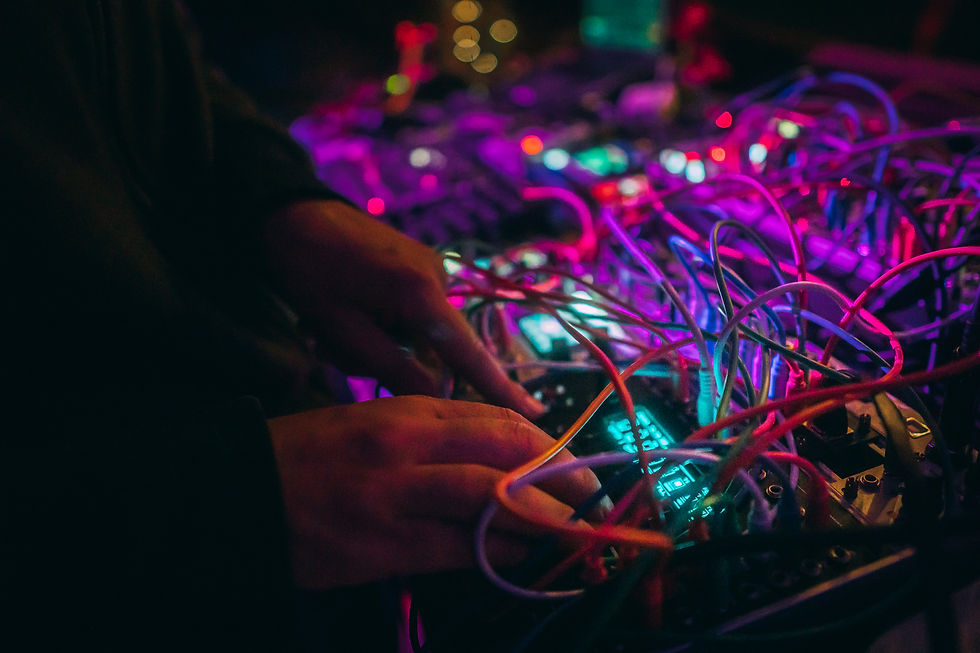
Your practice moves between the organic and the digital, the shamanic and the technological. Do you see electronic music as a way to recover ancient forms of ritual through contemporary tools?
Well, I'm not the best person to talk about it because I've never really studied the subject like a historian, but from my limited knowledge of the subject, I see similarities that lead me to believe this could be a way to rediscover some ancient forms of rituals.
Let’s look at what organically emerged in the underground alongside this music. Raves, chillouts, psychedelic art festivals, etc… Initially, underground culture is not only about parties where to dance. It’s about communities growing up like tribes with their own codes, where music acts as a fundamental human bond and fosters a collective mindset, inspiring also other kinds of arts co-living with music, like painting, graphic design, dance, food, and even political ideas. In this context, I can imagine that the DJ or any artist playing electronic music acts like a kind of shaman, guiding the group in a physical ritual: that of dancing. It’s all connected, music can’t be taken apart, as everyone dances in harmony with the vibrations and sometimes reaches higher states.
This reminds me of what occurred in ancient rituals, with shamanic music, ceremonies, psychedelic consumptions, and collective trance state. Then, I don't know if it's entirely accurate to speak of an "ancestral" ritual, given that it's a pattern that can be observed across several eras of humanity in different tribes on different continents. I believe it's primarily something inherent to the human species, especially when living in small groups and in close contact with nature. I wouldn’t see this as a return, rather as a continuity, as we decondition ourselves from our civilizational context which unfortunately disconnects us a lot from our deep essence.
One sure thing is that music technologies, such as drum machines, samplers and synthesizers, allow us to produce and even explore in greater depth certain ritual music through the automation of repetition. It implies a different way of playing, making it less energy-intensive for the artist, who no longer needs to perfectly play the rhythm with his hands following the exact tempo without deviating from it so as not to break the trance-like state induced by the rhythmic cycle, even though playing manually repetitive rhythms can induce a meditative state to the musician himself as it supposes a deep focus. In this context, there is no good or bad thing about that, just a question of intention and what one’s focusing on.
Music technologies like synthesizers or some samplers also allow us to overcome the limitations imposed by the very nature of acoustic instruments as it allows us to process music at an almost atomic level, since we work directly at the audio signal level. With a bit of music and scientific knowledge on the subject and a lot of work on sound design, I’m convinced that it's perfectly possible to produce a sound that induces a trance-like state, as was done, or still is done today in certain communities, with traditional instruments like the didgeridoo, sitar, harmonium, or whatever, even though the sound is obviously different in terms of textures.
In conclusion, the predominance of the trance state and the possibility to induce it with electronic music in a ceremonial context leads me to think that this could be a way to recover these forms of ritual.

Field recordings, modular synthesis and improvisation coexist in your process. How important is the element of unpredictability in keeping the music alive and human?
Well, as I evolve in the experimental field, I keep on giving a lot of space to intuition, experimentation and feelings at the present moment, because yeah, it’s the core thing in music. It’s what makes it sound alive, sure. But despite this, my way of music remains very processed, really, because I still have a strong perfectionist part in myself, and a terrible need to control things like some subtle details and clarity in the sound design, as well parts of the construction of the track. My way of making music lies in a balance between control and looseness, I'd say.
Everything is based on jams I’m doing in my home studio, with a constantly evolving workflow meticulously patched to give me an ability to control almost every parameter of sound and route each signal from each machine or plugins on the computer to any effect with very few restrictions, in a fluid way. Jams are the key moment of unpredictability as this is a pure moment of looseness. I play with sound like I would with modeling clay. I try to give life to musical forms that exist only in my head. Sometimes I try to experiment new things with the sound. But it's never totally random as I'm following a precise art direction. My workflow is specifically designed to follow this art direction, anyway.
Sometimes, while working, a "happy accident" happens. I allow serendipity in my music as I really love it. Sometimes, I throw it away because I hate what I hear, haha. And most of the time, it’s just whatever I had in mind and managed to design by patching the modular system, by configuring parameters on the different machines, by treating samples, or whatever, like, for example, when I try to apply mathematical rhythm patterns like euclidean rhythms or polyrhythmies, or try to reproduce some ethereal or psychedelic textures. I don't have any limit in terms of tricks or tools used, the most important thing for me is to find a way to do what I want to do, especially drones, dubby chords, dreamy pads, glitchy drums, etc…
In my process, as soon as I have all the matiere and feel that I can do something with this, I record the jam on my DAW, Bitwig Studio. Then, of course, I sort, I eliminate, I filter, I arrange the sounds, I add extra layers of effects when I feel it’s needy, and I mix it all in the DAW. It’s the controlled part of the process. Sometimes I even stack some different jams and can get surprised by the magic it produces, but generally the only unpredictable thing comes from the present moment, during the recording, during the jam moment, once I've established a sound design that resonates with me enough to play with and let my instincts express themselves freely without any constraints.
The EP suggests an ascent - a movement toward light, dreams and energy. What kind of awakening do you feel we are collectively moving toward, if any?
Well, I'm not sure that there's such a collective awakening as we could spiritually imagine, since spiritual awakening supposes mindfulness beyond ego and manichean reflexes, and a deep understanding of the world as an organic unity, but there is for sure a rising of energetic intensity on our planet, as well as some social evolutions and probably greater awareness for some individuals.
The thing is that in humanity we all have different life experiences, perspectives, intellectual predispositions and ultimately, different levels of consciousness. In this context, I think the evolution of awareness is more inherent to each individual than Humanity as a whole, even though there are probably mass effects relative to this evolution, as there are more and more people looking at the world we’re living in with a wider perspective and expressing a desire for positive change, especially among younger generation, who question what has always looked like an obvious predetermined order of the world while it remains problematic for lots of humans, and even animals, and become aware of global issues like climate change and depletion of material resources for example, and share a clear vision of the toxicity of this high-level capitalist system for our ecosystem, our sustainability and our mental health.
In the same dynamic, some are minding the threat of individual freedoms, as well as the place of women in this world still too entrenched in patriarchal reflexes, the latent racism in our Western society, the problem of animal-based food consumption and food waste, the problem of social injustice and unequal distribution of wealth, etc… Some people evolve at other steps of the journey, more into individual introspection, in the search for meaning in their lives, wondering how to be more in harmony with themselves, seeking a way to find inner peace, or simply trying to understand the cosmos more deeply.
In this regard, it seems obvious to me that there is an evolution of awareness on an individual level. But it’s not yet collective as it doesn't concern everyone since in the same time, lots of people still keep on reasoning only with their built-up point of view and beliefs, like if it were a universal truth, without questioning their perspective on our common reality nor trying to know themselves a deeper way and understanding themselves as part of the whole, sometimes even among those who defend progressive and supposedly benevolent viewpoints.
And unfortunately, an important part of people is training us collectively to a global regressive path, fuelinging hate and far-right extremism or religious extremism projecting their induced beliefs, or keep on defending high pressure on our environment with the pretext of economic concurrency and economic rising in a context of civilization collapse, or keep on feeding wars and divisions, like those stupid politicians who dare to flout international laws, enrolling citizens into wars, like in Ukraine, or committing genocide, like in Gaza… and that's truly frightening, because the World is becoming dangerous, unstable and chaotic, and facing this, I feel constantly lost and not able to find meaning in that, even though I try not to judge but understand other perspectives.
So yeah, about a kind of true collective awakening, when I observe what happens in the world, especially now, I don't think I will be able to find an answer to this very complex question that looks like an unsolvable puzzle in my mind, but I don't really believe in this. It’s true that we’re living in a period of high intensity in terms of energy, but this is not properly what I’d call a collective awakening. Sometimes I try to tell myself that perhaps we're supposed to go through this path to grow up collectively, to remind us the true nature of life, or bringing with us those most resistant people to change, and manage to detach ourselves from our own habits in this aging world that still clings to patterns that clash with the overall reality. But I'm not really sure that's the real purpose.
Honestly, I don’t have a response. In this context, it looks more like we're witnessing a growing split within humanity between those who accept to grow up and change, and those who feel discomfort with those requirements of change and abandonment of old beliefs, for lots of debatable reasons in a way. The only thing I'd like to say is that the ascent path I gave with this EP by ordering tracks in this direction to follow up this ascent idea is more reflective to a part of my own path of evolution rather than an idea of collective evolution. It’s proper only to my own experience, and can't be relevant to everyone like a global truth, even though I'd hope for everyone to live something similar, to raise his mind, to open up and develop a clear vision of life and get out of judgment to just observe and find his place and live a good balanced life, between positive experiences and lessons from dark sides of life.

Cyberlife Series feels like more than a label - it reads as an evolving ecosystem. As it moves forward, do you see it becoming an archive, a laboratory, or a community in transformation?
I could see it becoming a bit both a laboratory and an archive. EPs I release on my label are actually fruits of experimentation, but everything is thought to be in accordance. I don't make tracks just to make tracks, I try to tell a story with 3, 4, 5 tracks, and once I feel that I reached a step in the maturation of my style with those tracks, and once those tracks reason together in coherence, I consider the chapter of the Cyberlife Series I'm writing reaches its final state and is ready to be shared with the world.
Cyberlife Series is just a part of my art, a material one, and also what I would love to see on a label: a platform that puts art in the core of attention and stands like a comfort zone where an artist can be entirely be himself and express himself in a pure uncompromised way, and keep a kind of control over everything relative to his art and message, including visuals, setting as well business-specific and social hype trends issues in the background despite some realities like economic constraints.
I'm doing almost everything myself : the website I coded as I'm a web developer aside from music, the visuals as I love doing graphic art and connecting it to music as well, the text to illustrate each release, the music of course… Only mastering, that is done by Aes Dana from Ultimae, physical vinyl pressing, and part of the digital and vinyl distribution is not my own, at least not yet. But globally, yeah, it's my own, since I've always been into DIY things and think that's maybe the best way of being free and entirely satisfied.

And if this EP were found in the future as a document of our present, what would you want it to communicate about our relationship with technology, the body and transcendence?
I don't know if I can really communicate about this relationship through this EP, because it's not really the thing. It's beyond technology and the question of tools. It's all about acoustic vibrations. The nature of the music itself, the vibes and reaction with the brain. Technology is just a way to provide the vibes, but it can also be provided by classic acoustic instruments. It's true that I'm doing music with high technology, but I use it only like instruments I master. The most important thing is the content. What makes me feel tripping, where I'm going, what happens in my mind, etc... Transcendance is a natural reaction of mind and body to this elevated stimulus, music is the stimulus, technology's one way to create this stimulus. Nothing more.
Commenti