


Desira: "We inhabit our influences"
- Andrea Ghidorzi

- 21 lug
- Tempo di lettura: 4 min
We inhabit the influences that make us feel part of something.
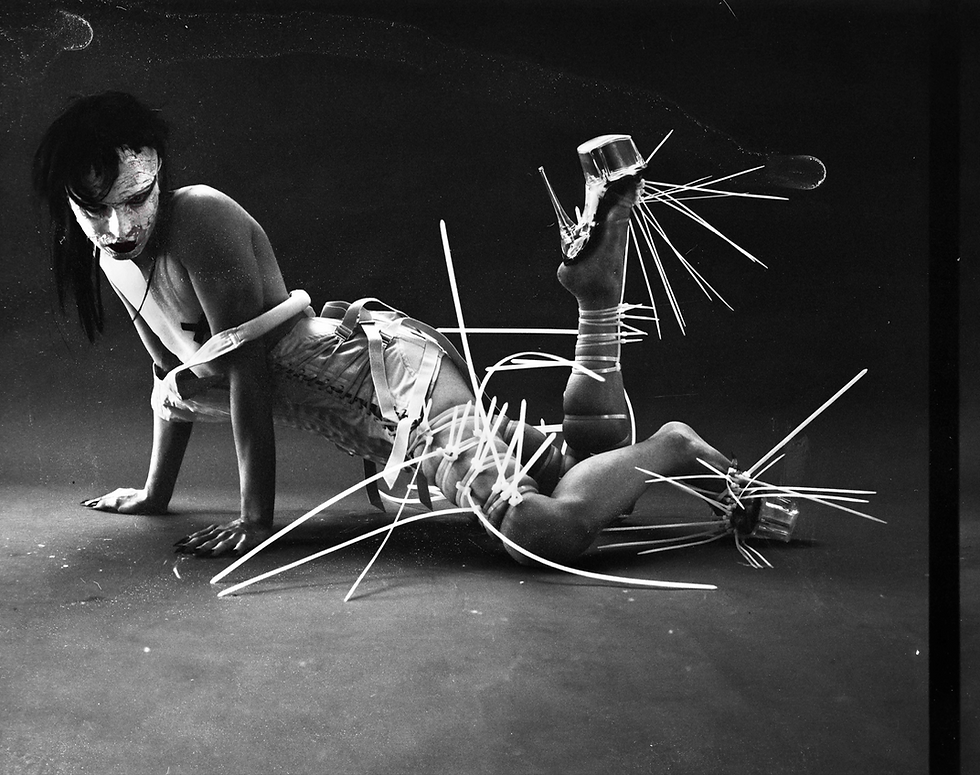
Every image, every ritual, every expectation leaves a trace, quietly shaping the way we move through the world and the way we learn to inhabit ourselves. At Moan Studios, we are interested in these invisible architectures - the forces that blur the boundaries between memory and performance, freedom and conditioning, the organic and the constructed.
In AMARA, Desira navigates those tensions through a language where body, sound, and symbolism become inseparable. Rather than offering certainty, her work invites us into a landscape where transformation begins with confrontation, and where the body remembers what the mind is often unwilling to acknowledge. Throughout this conversation, one idea continues to echo above all: we are constantly influenced, and eventually we inhabit the influences that make us feel part of something.
Welcome. In AMARA, the body seems to exist simultaneously as a refuge, a battlefield, and an archive of memory. Do you think the body preserves traces of experiences that language is unable to tell?
Absolutely. The body holds onto everything and carries the weight of our lived experiences wherever it goes. Unlike the mind, it is far less capable of convincing itself that it has forgotten. AMARA is fundamentally about this: mental wounds expressed through physical actions. The world I created is rooted in symbolism and surrealism, making it deeply psychological, yet every action described in the songs and shown in the short film is always physical. What surprised me most is that I only realized this once the project was finished. Looking back, I saw that every trauma I wanted to explore had been translated into a precise bodily gesture.
The project explores self-destruction not only as a wound but also as a possibility for transformation. Do you believe that destroying a part of oneself can, at certain moments, become a necessary act for survival or rebirth?
This connects directly to what we were saying about the body. AMARA revolves around its destruction and transformation. Mutilation is a word that may sound provocative, but for me it is extremely accurate. For many people in my community—and for myself—the destruction of one's biological body can represent rebirth. That idea became the silent force driving the entire project: the belief that dismantling a system can become an act of truth, empowerment, and freedom.

Beauty and discomfort constantly coexist throughout your work. Are you interested in the idea that some truths can only be understood through what makes us uncomfortable?
I believe an artist's primary responsibility is to confront their own darkness—their inner monsters—and transform them into something that can be shared. I discussed this with my psychologist. We realized that becoming aware of our worst parts is essential if we want to live peacefully. At first, we always try to eliminate or ignore them because they seem incompatible with the image we have—or want to have—of ourselves. But eventually you understand that true acceptance begins when you stop judging them. Many truths only become understandable by passing through the discomfort they create.
We live in an age where much of our experience is filtered through images and representations. Do you think it has become more difficult to inhabit one's body authentically, without constantly turning it into something to display, improve, or perform?
I think it's impossible to live in a completely authentic way—and perhaps that's exactly how it should be. We are constantly influenced, and eventually we inhabit the influences that make us feel part of something. It's an inevitable process. Right now, I don't even feel capable of saying whether that's good or bad. I only know that it happens, and that it's probably far more beyond our control than we'd like to admit.
AMARA seems to emerge from a constant tension between what is imposed and what is chosen. Do you think freedom today lies in constructing a new identity, or in escaping the obligation to have one at all?
Absolute freedom is unattainable. The only freedom we can truly experience is personal, and therefore deeply subjective. Some people find it by building a new identity, while others find it by rejecting the obligation to define themselves at all. I went through a period in my life where I constantly asked myself who I was. At some point I stopped searching and started embracing. That doesn't mean becoming free from the mechanisms that influence us—it means letting go of the obsession. In my artistic practice, however, I love shedding my skin. I've already planned my projects through 2032, and each one explores a different part of myself and of the world I perceive. That's why every new universe has to transform radically.
Your practice merges sound, image, and performance until it's almost impossible to separate one language from another. Do you believe art still has the power to generate collective awareness, or do the deepest transformations now happen mainly within the individual and the intimate sphere?
I think it's very difficult today for art and music to generate the kind of collective consciousness they once did. They can still transform people, but they do so privately. The biggest difference is that we now live inside different bubbles. I can open Instagram and see one version of the world, while someone else opens it and sees something completely different. Mass media, for better or worse, used to create shared imaginaries. Influence still exists today, but it unfolds within much smaller and far more fragmented communities.
Looking ahead, we can imagine a world where the body becomes increasingly modifiable, digital, and hybrid. In such a scenario, what do you think will remain irredeemably human?
First, we would have to agree on what we actually mean by human. If I had to identify the traits that have accompanied us throughout history, I would probably say domination, arrogance, and recklessness. I have a feeling those qualities will remain with us even when we become completely bioengineered.
Commenti